
Welcome to the information page for our proposed grid stability project in Ramsgate, Kent.
This page includes details about our plans for the site, and how to get in touch with the project team.
In August 2026, Conrad Energy submitted a planning application to Thanet District Council setting out proposals for the construction and operation of a grid stability facility with ancillary infrastructure, and associated works, including access and landscaping. The application submission follows a detailed design process informed by the completion of various surveys and assessments.
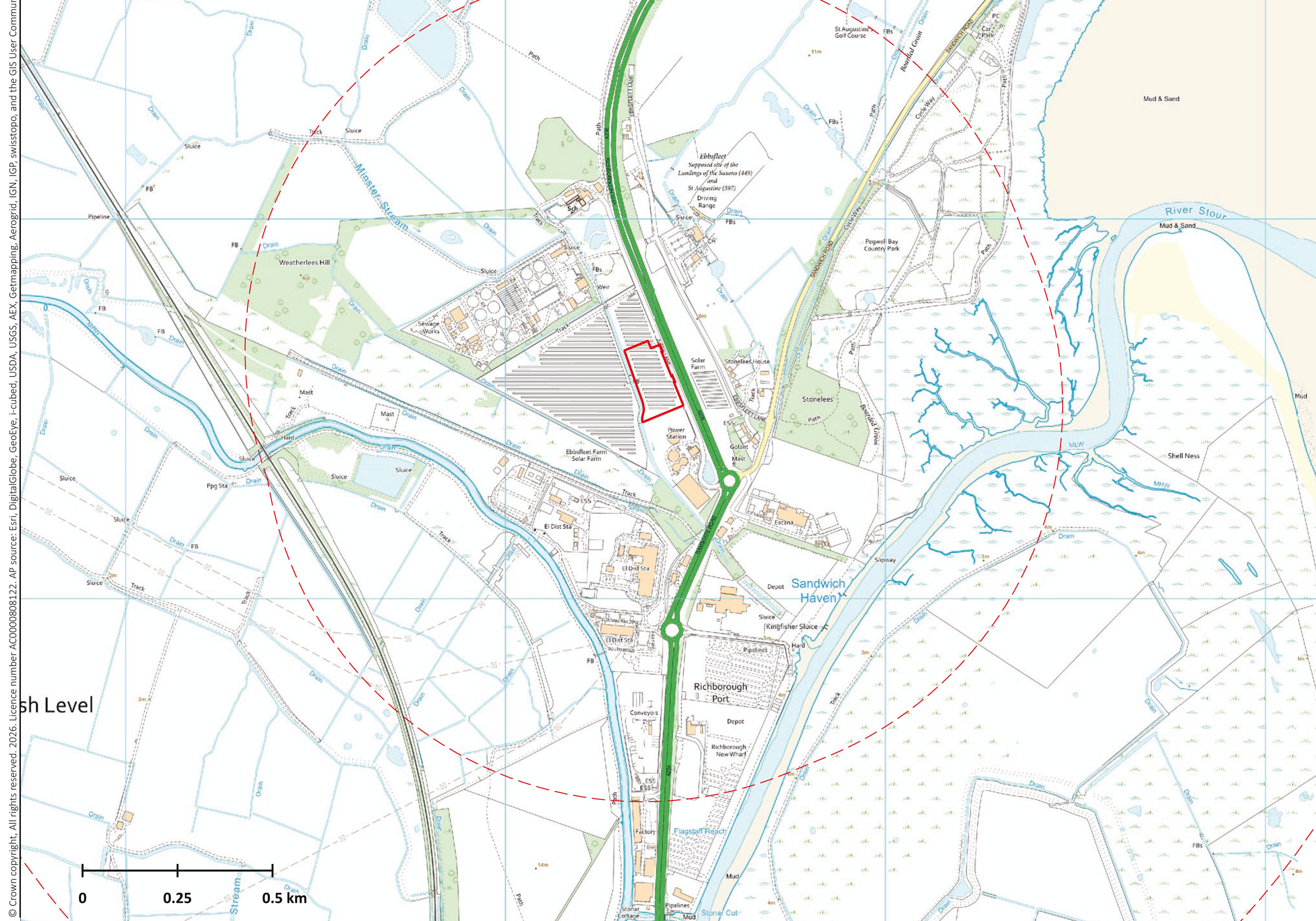
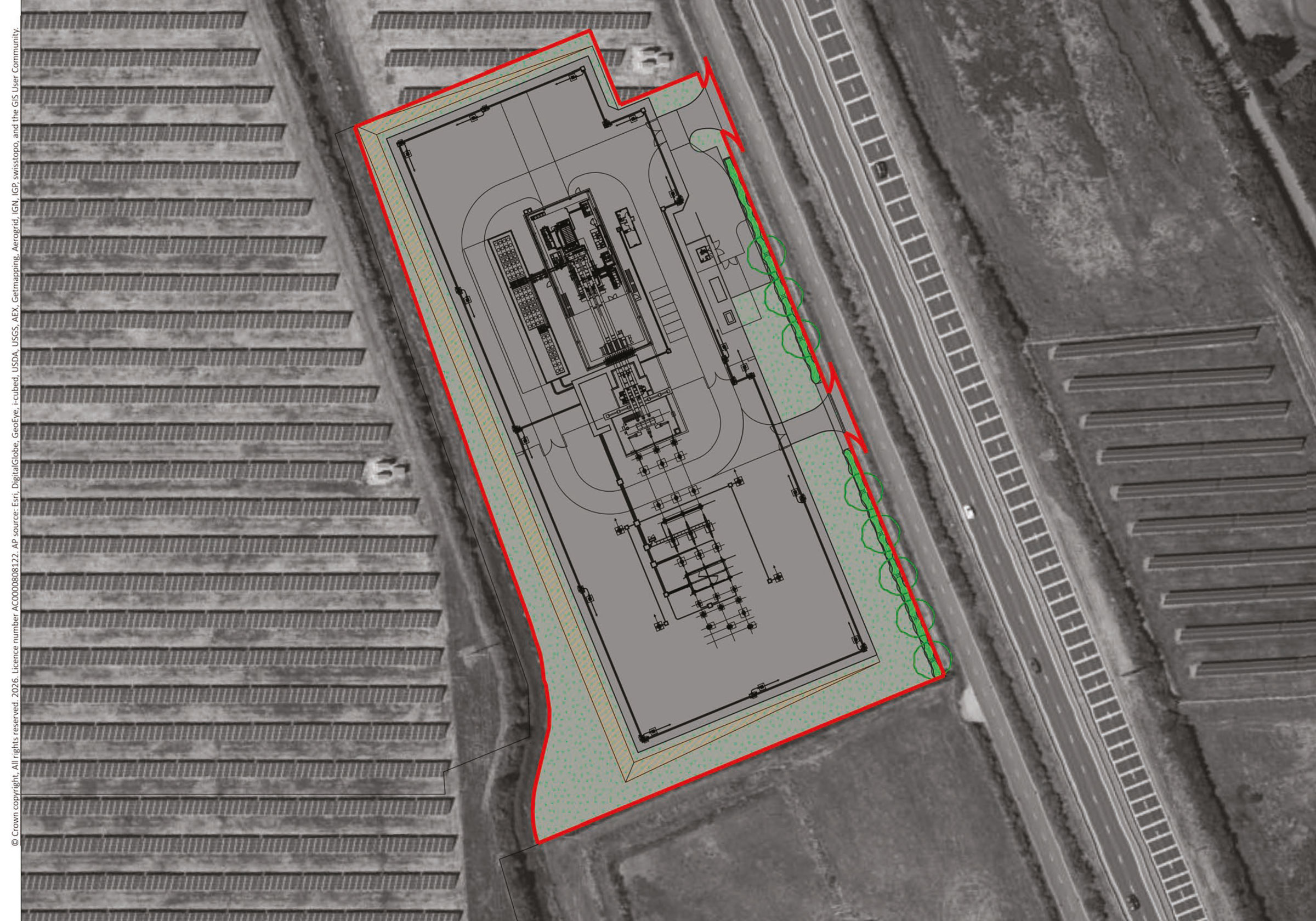
The project is located on land at Ebbsfleet Farm, off Jutes Lane in Ramsgate near to the National Grid’s Richborough Substation. The location of the project is shown below or can be viewed on what3words’ interactive map here ///budgeted.sensible.paddocks.
Construction update
We are pleased to update that we are moving into the next phase of construction for our synchronous condenser site at Walpole.
Several of the largest pieces of equipment required for the synchronous condenser have now been built and will soon be making their way by road from Sutton Bridge to the Walpole site.
They will be major logistical operations, echoing last year’s epic equipment movements to our existing Pathfinder project at Eye. If you’d like to watch video footage from last year, please click here.
The map below details our intended route on the dates outlined below. The schedule is subject to change, but we anticipate these movements taking place between 6am and 9pm dependent on the equipment being delivered and therefore the size of the vehicle. The deliveries will also be paused to allow for school traffic where relevant.

As many of the transportations as possible have been planned for Sundays to minimise disruption on the roads.
- On Sunday 18 May, the first transformer will be transported from Sutton Bridge to the Walpole site.
- On Thursday 22 May, the second transformer will follow the same route.
- On Sunday 22 June, the first generator will begin its journey from Sutton Bridge, travelling part of the way to site.
- On Sunday 29 June it will complete its journey to Walpole.
- On Sunday 6 July, the second generator will begin its two-stage journey from Sutton Bridge.
- On Sunday 13 July the final leg, bringing the second generator to Walpole should be completed.
Motorists and pedestrians are advised to:
- Exercise caution along the planned route during the time of movement.
- Follow all instructions provided by traffic marshals and police.
- Allow additional travel time where applicable.
Please refer to the link below for a public announcement from your relevant Constabulary, with details of the deliveries:
- Lincolnshire (Sutton Bridge, start of the route): www.lincs.police.uk/news/lincolnshire/news
- Cambridgeshire (passing through Wisbech): www.cambs.police.uk/area/your-area/cambridgeshire/fenland/wisbech/news
- Norfolk (approaching site): www.norfolk.police.uk/police-forces/norfolk-constabulary/areas/campaigns/campaigns/abnormal-loads
We’d like to thank the teams who have put in the planning along with the police and local authorities, those who will execute it and the communities along the route for their patience.
Why is the project needed?
In April 2019, the Electricity System Operator (ESO), then part of National Grid, set itself the ambition of being able to operate Great Britain’s electricity system with zero carbon by 2025, whenever sufficient renewable generation was available.
Traditionally, fossil fuel power stations have been needed on the network to provide necessary services such as inertia, voltage, frequency and short circuit level controls that help keep the network at its optimal operating levels.
To reduce this reliance on fossil fuel generation, National Grid ESO launched its Stability Pathfinder programme. These projects are designed to save consumers millions of pounds. Find out more about our Pathfinder 3 grid stability projects, Walpole and Eye.
Since October 2024, responsibility for operating Great Britain’s electricity system has transferred from National Grid ESO to the National Energy System Operator, NESO. NESO is now continuing this work, including through its Long-term 2029 tender, which is seeking stability, voltage and restoration services across Great Britain from 2029 onwards.
NESO identified areas of need where there were stability requirements on the network and issued a tender to procure services and proposals to deliver sustainable solutions.
As part of this Grid Supply Points (substations) were identified where there is space to connect the new equipment. Richborough Substation is one of those identified as suitable to support the Long-term 2029 scheme. It is one of few substations within the region that has capacity to connect new technology.
The grid stability facility consists of a synchronous condenser (sometimes called a synchronous capacitor or synchronous compensator) which is a specialised piece of equipment that does not generate power but provides stability and short circuit power to the electricity network. This plant essentially provides the stability and protection in the case of a fault that renewable generation cannot.
The project is a critical element of the infrastructure required to maintain a secure, resilient and reliable electricity transmission network while enabling the continued growth of low-carbon electricity generation across Great Britain.
Why has this site been chosen?
We have carried out a detailed site assessment of the area around National Grid’s Richborough Substation. We considered a number of factors, including proximity to the national transmission system as well as potential impact on sensitive receptors such as residential or ecological sites, access, planning restrictions, topography and ground conditions.
The proximity of the site to the National Grid substation is key. The effectiveness of the equipment is directly correlated to the distance between the condenser and the substation. The further away it is, the more its performance is reduced by the cable connection, limiting its ability to provide vital grid stability services when they are needed.
Following careful assessment of the planning requirements, the available land at Ebbsfleet Solar Farm is the most appropriate site for the project.
Project information
- The site footprint will be approximately 2 hectares and include a synchronous condenser unit and ancillary infrastructure including external cooling fans, an enclosed diesel generator and small fuel tank, transformers, flywheel, cabling and containerised control equipment.
- The development will be secured by a 2.4m welded mesh compound fence around the perimeter.
- Access to the site during construction will utilise the existing route off the Ramsgate Road/A256 roundabout to Jutes Lane, the anaerobic digestor and the solar farm.
- Operational traffic will also use Jutes Lane and is expected to be minimal with site visits planned for occasional maintenance via light van or 4×4 type vehicles.
- To support visual screening a landscaping strategy incorporates native hedgerows, trees and wildflower planting into the site design which also contribute towards local biodiversity measures.
- Employment generation is expected to be two full-time staff, locally based, for the operation and maintenance of the plant.
- Noise from the development will be minimal with mitigation measures incorporated such as the lining of the synchronous condenser building with a composite cladding system. A full noise impact assessment has been carried out which finds the development to have no impact on nearby sensitive receptors.
- Proposed development is temporary and reversible, with a modelled operational lifespan of circa 40 years.
Project plans
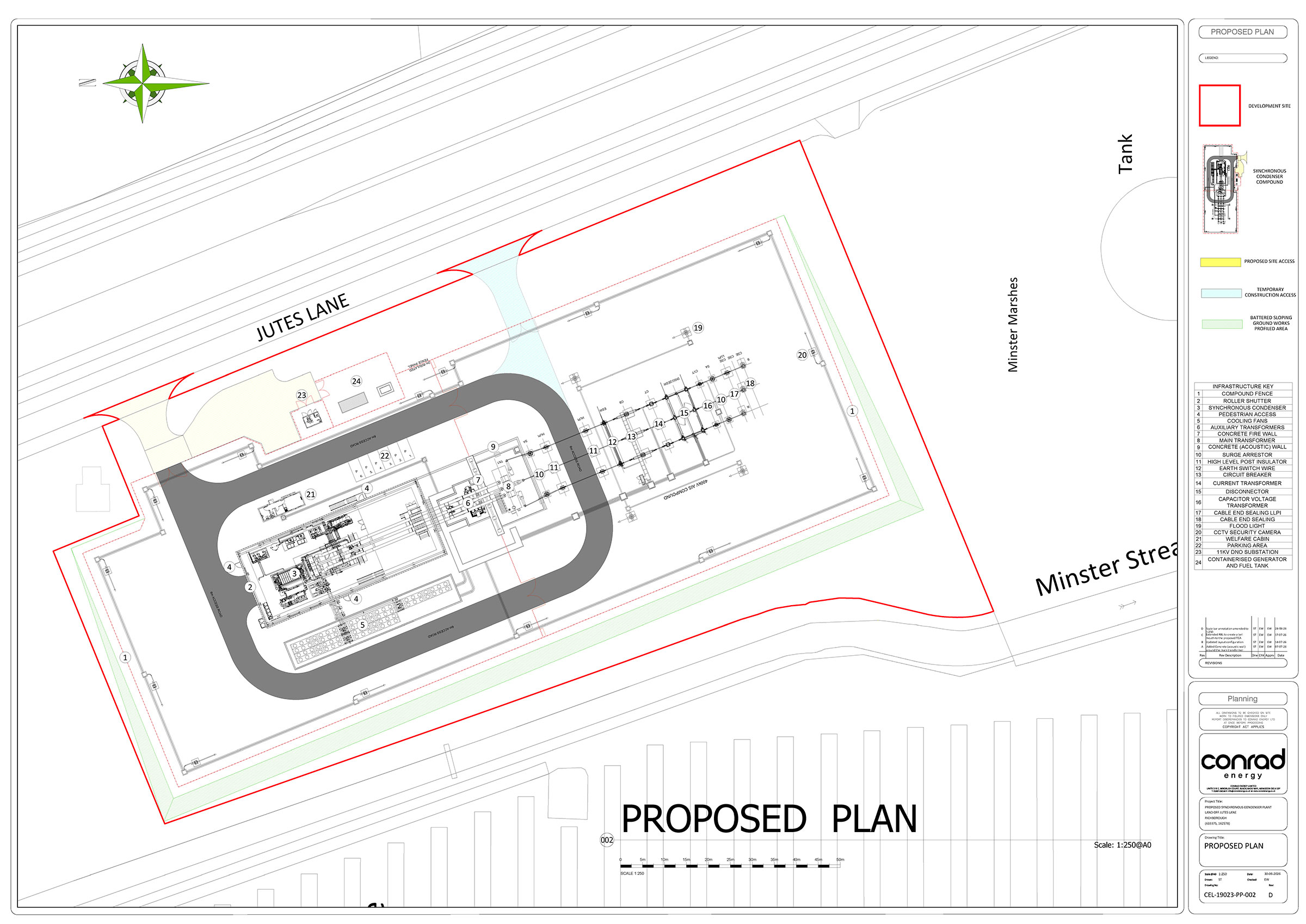
Click to view PDFs of the below plans:
Project timeline
August 2026
Planning application submitted
November 2026
Planning decision expected
July 2027
NESO contract award anticipated
September 2027
Construction starts
October 2029
Energisation
All timings are indicative and subject to change as the project progresses.
FAQs
Synchronous condensers (sometimes called synchronous capacitors or synchronous compensators) provide stability and voltage support to the electricity network, including when faults or disturbances occur within the power grid.
They do not generate electricity but produce or absorb reactive power to keep the current flowing consistently to the grid, this helps to ensure reliable power is available for those who need it, when they need it.
The equipment is located within a steel framed, acoustically clad building, which is connected to a National Grid substation.
Network stability is an inherent by-product of synchronous generation from coal and gas plants. As these fossil fuel plants are phased out and more power is produced from wind and solar, there is a decline in the stability of the system with inertia (mass of the system used to control frequency) and short circuit levels (amount of current that flows on the system during a fault) falling.
Synchronous condensers help stabilise and balance the grid in two key ways:
- Inertia – Many generators producing electricity for the grid have spinning parts – they rotate at the right frequency to help balance supply and demand and can spin faster or slower if needed. The kinetic energy ‘stored’ in these spinning parts is our system inertia. If there is a sudden change in system frequency, these parts will carry on spinning – even if the generator itself has lost power – and slowdown that change (what we call the rate of change of frequency) while NESO’s control room restores balance. Inertia behaves a bit like the shock absorbers in your car’s suspension, which dampen the effect of a sudden bump in the road and keep your car stable and moving forward.
- Short circuit level – Short circuit level (SCL) is the amount of current that flows on the system during a fault. These faults can be caused by a lightning strike, weather conditions or equipment failure. During the fault, the system can see a direct connection to the earth and current flows from all sources into it. SCL is vital during such a fault as it helps us to maintain system voltage. If we get a disturbance, then a stronger system will dampen it out quickly. It is just the same as how a strong bridge with re-enforced joints would wobble but settle quickly when placed under force. If we operate a system with low SCL, it may take longer to recover after a disturbance.
The synchronous condenser will make a noise when operating, typically a buzzing or humming sound – similar to a substation. To minimise noise externally, the equipment will be enclosed within a steel building with acoustic cladding.
We appointed a specialist noise consultancy to undertake a noise assessment for the site. The assessment took into account the existing sound levels in the area and considered how much / if any noise would be heard at various locations near to the site, including nearest properties.
Following the noise assessment survey results and to ensure that the noise from the synchronous condenser would not be above background level, the cooling fans have been strategically located away from receptors, and two acoustic barriers have been integrated as part of the scheme.
The report demonstrates that noise levels at the nearest sensitive receptor would be acceptable in line with national guidance.
The electromagnetic fields produced by a synchronous condenser are negligible, similar to those produced by a large generator.
Conrad Energy takes the issue of health very seriously. We believe it is right that the decision on what is acceptable or not is made independently of industry.
Accordingly, we design all our equipment to comply with the UK Health Security Agency’s recommended exposure guidelines. Research has been done into the possibility of health effects, without establishing any risks below these levels.
The equipment will be housed within a 15m high warehouse, similar a large agricultural warehouse and to the adjacent National Grid housed substation.
To reduce visual impact, we are proposing screening though hedgerows, trees and wildflower planting, and a green colouring of the building has been chosen to meet the natural aesthetic. Darker and mid-green shades are proposed in the design to allow the lower parts of the building to recede in views, in relation to the existing vegetation near the site and also in relation to the proposed landscape mitigation. Lighter green on the highest-level is designed to allow the upper parts to recede when seen against the sky. This cladding design reflects similar successful elevation treatments for nearby existing buildings in Richborough Energy Park.
Each application is assessed individually and where required a flood risk assessment completed to support a planning submission. This will assess whether there are any potential impacts and incorporate mitigation as necessary to ensure there is no increased flood risk from the development.
The flood risk assessment submitted as part of the planning application demonstrates that the site is largely situated in Flood Zone 1, however an area of the site to the southwest is situated in Flood Zone 2. The report outlines how this has been mitigated.
As part of the planning submission, we have provided details on the access route and number of predicted vehicle movements. The main impact would be during the initial phase of the construction works, when there would be a number of HGV movements.
A Construction Traffic Management Plan has been provided to support the planning process, setting out how we will manage and control vehicle movements to minimise any impact. Once operational, there will be negligible traffic movements as the site is monitored remotely with 1-2 weekly maintenance visits by a car or small van.
With all of our projects we want to make a positive contribution and enhance local ecology wherever we can. To achieve this an ecological survey is conducted to identify the conditions onsite. This informs our proposals and design. We look to incorporate a range of ecological enhancements.
This planning approval for the grid stability facility lapsed on 11 August 2026. This site has been bid into the same round of tenders for Long-term 2029 as our Richborough Grid Stability Facility. Only one site can be successful in this tender process.
The development is fully reversible, with an operational period of circa 40 years. The site would be fully restored to its existing condition on cessation of operations.
Human made climate change is the greatest threat facing the planet and its impacts are already being felt. The world is now warming faster than at any point in recorded history. From extreme weather events such as droughts and wildfires, record breaking rainfall and flooding, to the warming oceans, climate change is having an impact on our way of life across the world and closer to home too.
In order to reduce carbon emissions, we need to transition to a cleaner energy system. The UK has a legally binding target to achieve net zero greenhouse gas emissions by 2050. The Government’s Clean Power 2030 Action Plan also aims for clean sources to produce at least 95% of Great Britain’s electricity generation by 2030.
Meeting these ambitions will require more renewable generation, storage and investment in the electricity network. As wind and solar increase, technologies such as synchronous condensers can provide essential stability services traditionally provided by fossil fuel power stations.
Together, these technologies can help Great Britain move towards a cleaner, affordable and secure electricity system while keeping the network stable and reliable.
Keep in touch
If you have any questions about the Richborough Grid Stability Facility, please get in touch.
Email: richborough@conradenergy.co.uk
Post: Richborough c/o Conrad Energy, Suites D&E Windrush Court, Blacklands Way, Abingdon, OX14 1SY
To receive email updates on the project please subscribe below: