
Welcome to the information page for our proposed 500MW battery energy storage system (BESS) near Moffat 400kV Substation, which Conrad Energy is proposing to construct and operate..
It includes details about our current plans for the site, and ways to share your feedback.
The project would facilitate the import and export of power to the electricity grid network.
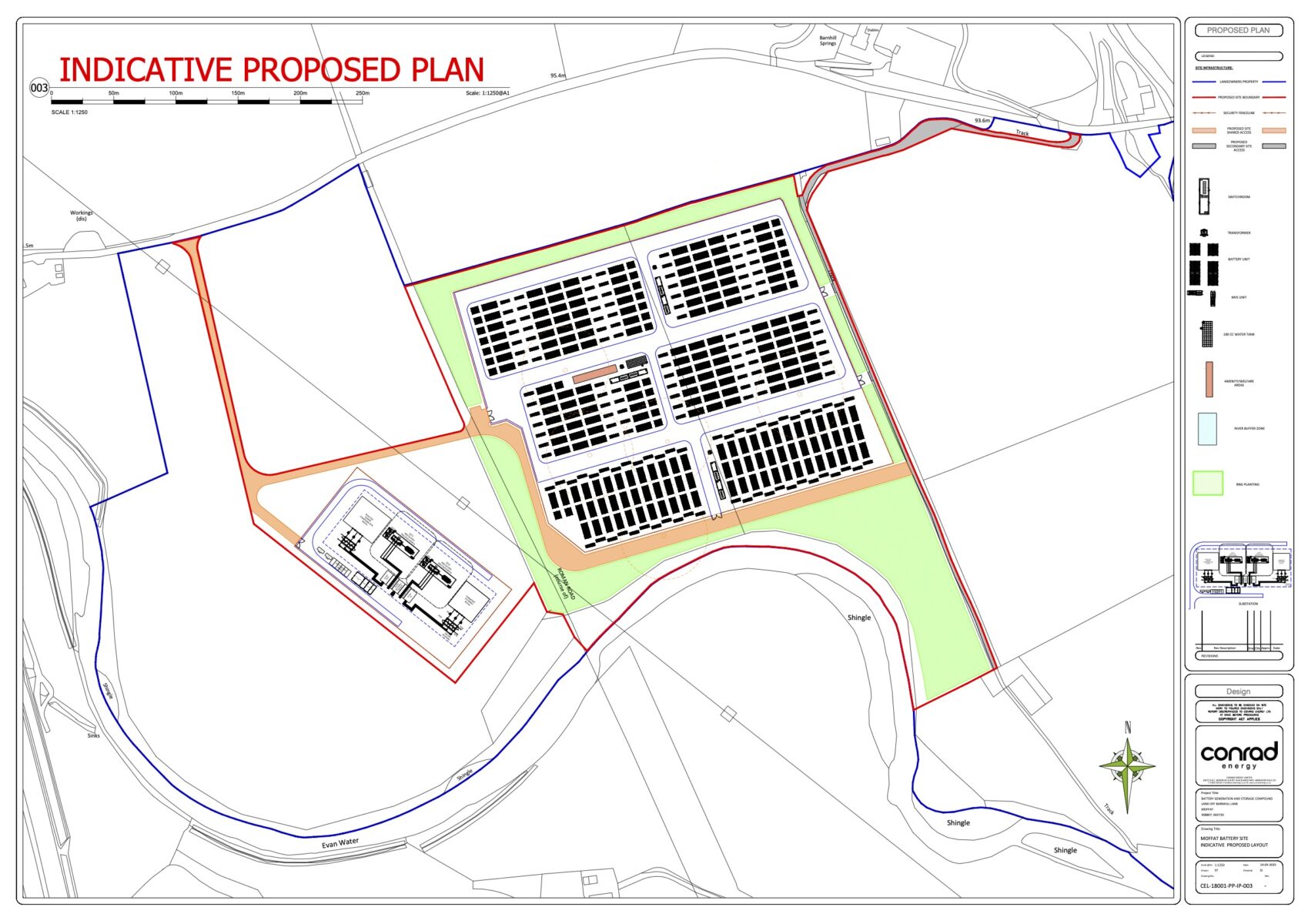
The proposed location is to the south of Barnhill Lane, Moffat and District, 55°18’36.6″N 3°26’20.3″W. The project is located approximately 1km north of the existing Moffat 400kV Substation and approximately 1km east of Beattock village, separated by the A701 road and the A74 motorway. Although located in Moffat and District, Moffat town is located 2.5km north of the proposed site.
Connecting to the available grid capacity at Moffat 400kV Substation, it would provide cost-effective, flexible energy during peak electricity periods or times of system stress. Batteries also provide frequency services that help stabilise the grid network. As demand for clean electricity grows, battery storage projects like this one are vital in providing flexibility to the grid.
The location of the project is shown below or can be viewed on what3words’ interactive map here ///cakewalk.casually.purifier

Our planning application will be made to the Energy Consents Unit (ECU) at Scottish Government and we are hopeful that they will support it. The proposed BESS can work in conjunction with existing local renewables, ensuring that the area has power when the wind doesn’t blow, by storing it when existing turbines are generating more than is needed.
The Council where the project is located, Dumfries and Galloway have an extremely impressive record of cutting carbon emissions. Last year, Convener of Dumfries and Galloway Council, Councillor Malcolm Johnstone, said:
“We have reduced our carbon emissions by 51% between 2018 to 2023, which is an astounding outcome. By reducing our own emissions, we are in a better position to lead by example, encouraging other organisations to set and achieve strong climate change goals.”
This BESS project would be another step in that direction, reducing the need to call on fossil fuels when the weather isn’t cooperating.
On a national level, the Clean Power 2030 Action Plan (“CP 2030”) sets out the generational capacity required to meet the government’s target. CP 2030 states that 23 – 27 GWs of BESS are required to meet the 2030 targets. This demonstrates that the government continues to see BESS as a key part of the renewable energy landscape.
Project key facts
- The 500MW of storage of the site can meet the average electricity needs of 1.62 million UK homes (assumes 3800kwh/yr average usage per household).
- The developable site is approximately 16 acres, subject to detailed design requirements. There is additional land for BNG, landscaping and habitat creation.
- There is a viable grid connection in proximity to the site with space to connect new electricity storage.
- There is good access to site from Barnhill Lane, off the A74 motorway. The vast majority of the vehicles will be 20ft rigid lorries and the number of HGV movements will be low during the construction period.
- With suitable and sensitive design, this project can have a low impact on the local area. For example, the design of the site will include proposed tree planting and landscaping to screen the development from local receptors. The area surrounding the development will be enhanced for local ecology and delivering Biodiversity Net Gain.
- Proposed development is temporary and reversible. The development will be fully decommissioned at the end of it’s life cycle.
What happens next?
It’s important to us that the local community are informed of our current proposals for the site and can comment and learn more.
We’d like to thank everyone who attended the in-person consultation events at Beattock Village Hall on Wednesdays 23 April and 7 May.
The pre-application consultation (PAC) report provided to the Energy Consents Unit (ECU) will address the points raised by your feedback both at those sessions and in the follow up period beyond. The consultation deadlines have now expired.
You will be notified when the application has been submitted to and registered by the ECU.
FAQs
The notice of the consultation are being published in the local paper DNG24 on Friday 11 April and Friday 7 May.

Several factors have led to the recent and ongoing challenges related to the supply, demand, and cost of energy in the UK. The energy crisis has led to increased living costs for households, financial strain on businesses, and significant political and public debate about the best path forward to ensure energy security, affordability, and sustainability in the UK.
For a clean, affordable and secure energy future the UK needs more renewables at home, and more storage – and it needs them quickly.
The UK’s energy transition involves shifting from fossil fuels to renewable energy to meet climate goals. This includes increasing renewable power such as wind and solar,, enhancing energy efficiency, and investing in modern infrastructure. Challenges include managing high costs, ensuring supply stability, and overcoming regulatory hurdles. The transition aims to reduce carbon emissions, improve energy security, and create a sustainable future, amidst rising energy prices and global supply chain disruptions.
The UK’s climate change ambitions are amongst the highest in Europe and require us as a nation to achieve net-zero greenhouse gas emissions by 2050. The British Energy Security Strategy (April 2022) set a target that ‘By 2030, 95 per cent of British electricity could be low-carbon; and by 2035, we will have decarbonised our electricity system’. More renewable energy generation and battery storage is needed to meet these targets.
Battery energy storage is critical to achieving net zero in the UK and battery projects are vital in providing flexibility and services to the grid. For us all to benefit from clean energy, we must be able to store and then distribute it during times of peak demand. Renewables are the cheapest new energy generating technology, as well as being quick to deploy. But if the rapid transition to renewable energy is going to be achieved, battery storage is key.
As more renewables generate our power, we need greater flexibility in the grid. The wind doesn’t always blow, and the sun doesn’t always shine, so we need batteries to balance the system. Storage can help make the most of green energy, using it to manage peaks and troughs in demand and operate the electricity system as efficiently as possible – keeping costs down too. This will become more and more important as the demand for clean electricity grows. According to National Grid’s Future Energy Scenario for 2021, up to 13GW of electricity storage will be required in the UK by 2030 to support the increased installation of renewable generation.
This depends on the design of the specific site, but typically the batteries are housed in containers, which need to be installed on a level platform. These are then enclosed by fencing to maintain security. Our proposals always seek to retain any existing trees and hedgerows around the site and are designed to fit into the area sensitively. As part of the planned design, comprehensive landscaping such as tree planting or bunds help to ensure that there is minimal impact on the local area.
When we assess the feasibility of a site, we carefully look at a wide range of factors such as the local landscape, site access, ecology, connection to the grid to identify and address any potential impacts the scheme may have on the local area. We always aim for our battery energy storage schemes to have a low impact on the local area and a high impact in grid stability.
The energy storage process does not have any sound emissions associated with it. But to make sure the batteries remain at the correct temperature; a series of cooling fans are used. As part of a planning application a background noise survey would normally be conducted which would model and then assess any levels of noise.
Each application is assessed individually and where required a flood risk assessment completed to support a planning submission. This will assess whether there are any potential impacts and incorporate mitigation as necessary to ensure there is no increased flood risk from the development.
As with anything we do, safety is fundamental. In designing and selecting equipment for the site, we ensure that all safety standards and legislative requirements are met. The battery storage modules are designed to have a very low risk of failure, and an even lower risk that any failure would result in an incident. Our battery storage projects are built and operated in line with industry best practice, with multiple layers of prevention and protection systems that minimise risk. Fire detection, monitoring and fire prevention equipment is installed in all the battery storage modules and onsite.
As part of the planning submission, we will provide details on the access route and number of predicted vehicle movements. The main impact would be during the initial phase of the construction works, when there would be a number of HGV movements. A Construction Traffic Management Plan is typically provided to support the planning process, setting out how we will manage and control vehicle movements to minimise any impact. Once operational, there will be negligible traffic movements as the site is monitored remotely with maintenance visits approximately every two weeks by a 4×4 or van.
With all of our projects we want to make a positive contribution and enhance local ecology wherever we can. To achieve this an ecological survey is conducted to identify the conditions onsite. This informs our proposals and design. We look to incorporate a range of ecological enhancements. For example, it might include bird and bat boxes, bug hotels, tree planting and grass meadows. Local knowledge and feedback can play an important part in this.
The development is fully reversible and would be fully restored to its existing condition on cessation of operations.
Tell us what you think
We’d like to hear your feedback to help us shape our plans. If you have any questions please get in touch.
Email: moffatbess@conradenergy.co.uk
Post: Moffat c/o Conrad Energy, Suites D&E Windrush Court, Blacklands Way, Abingdon, OX14 1SY
Comments made to the prospective applicant are not representations to the planning authority (Scottish Ministers) and if the prospective applicant submits an application there will be an opportunity to make representations on that application via the Energy Consents Unit.