If you missed our Alternative Land Uses webinar in conjunction with Farmers Weekly, “Love thy neighbour! Energy opportunities for farmers lacking grid connections,” the recording is available here.
We aimed to provide you with a little bit more insight and information on how you can mitigate your costs and/or create revenue streams through energy developments, but specifically what your options are if you have trouble getting a grid connection or you’re not located close to a grid connection.
We’ve summarised some of the key questions and answers from the session below.
How much money could I make from having an energy project on my land?
This is a bit of a ‘how long is a piece of string’ question because there are so many variables.
If you’re installing it, paying for it and using it in the longer term you will make money back because you’ll be generating much of the energy your farm needs and your energy bills will reduce. You’ll also have the chance to sell excess energy back to the grid for others to use. You can also store the excess, if your project also includes batteries to further reduce the amount you import from the grid.
If you’re renting your land to an energy company so they build and operate the site, you’ll receive rent based on how much land you lease out. You may also be able to negotiate fulfilling your energy requirements at a very favourable rate or even secure a share of the operating profit.
Will I incur any upfront costs?
That depends on whether you self fund the build or if you go with an energy company who will fund all the capital costs of the project itself.
If you do go with an energy company, be sure to choose a reputable financially stable partner with plenty of experience in this field – and one that will pay for your legal costs with a specialist firm as those costs can soon mount up.
Why is it so hard to get a grid connection?
Essentially, there is are a lot of projects in the queue and no matter how great your project might be, it has to join the back of the queue. One of the main reasons for this backlog are what we call ‘zombie projects’, where developers booked a place in the connections queue before they had a viable site and then didn’t move forward with the project. In combination with the slow pace of grid infrastructure upgrades, these blockages can cause long delays in getting a project live.
What are the income opportunities if I can’t get a grid connection?
Some farming enterprises, such as poultry, indoor pigs or dairy, are surprisingly high energy users. Utilising your own energy production (what is known as on-site or ‘behind the meter’) to offset your energy demand is a great way or reducing your dependence on the grid, slashing your energy bills.
Or, you might want to consider producing power that goes somewhere else within close reach This is called a private wire development, where you have an installation on your land that sends power directly through a cable to a high energy using neighbour.
What is the maximum distance that a business can be from the potential site to make a private wire possible?
Ideally, you want to be within 2km of the electrical connection point belonging to your commercial neighbour. Installation costs will be notably lower if there are no additional challenges, like roads to cross. There is also a voltage drop over distance, so the closer your land is to the user the better, and the larger the generation asset you’re creating the less notable those losses will be.
How long would the contract last for?
Ideally, you need to find a neighbouring business that is likely to be there for a significant amount of time. Our agreements tend to be 15-20 years long to make the investment worthwhile. A lease on the land might last up to 40 years.
What happens at the end of a contract?
Generally speaking, planning rules require that the land is returned to a similar condition to when it was leased. All the energy infrastructure is removed and the land is free for you to use as you did before.
What happens if I want to sell my land whilst I’m under contract?
It depends on the terms of your contract. However, generally speaking, you could sell the land but the installation would have to stay in place and the energy company leasing the site would transfer lease payments to the new owner.
How do I approach a neighbour to ask if they’d like to set one of these up?
If you already have a good relationship, it may be worth having the conversation directly. There are also many benefits to having somebody like Conrad Energy open the conversation for you. From their point of view, having an energy developer involved may simplify the process and help to formalise the agreement more quickly. It reduces the hassle and active involvement on both your part and theirs, allowing them to futureproof their own energy supply and reduce their bills with minimum effort. In this instance, Conrad Energy would pay to lease your land but would take care of the costs of legal, installation, planning and maintenance. Not only could you benefit from our experience but also from using them to negotiate what’s called a Power Purchase Agreement, or PPA, which is how the neighbouring business would purchase the power. These Agreements tie in both the cost of the energy and how long they will take (or ‘sleeve’) the energy from the installation on your land.
How much land would I need to set aside for one of these projects?
It depends very much on what type and size of project you were looking to build.
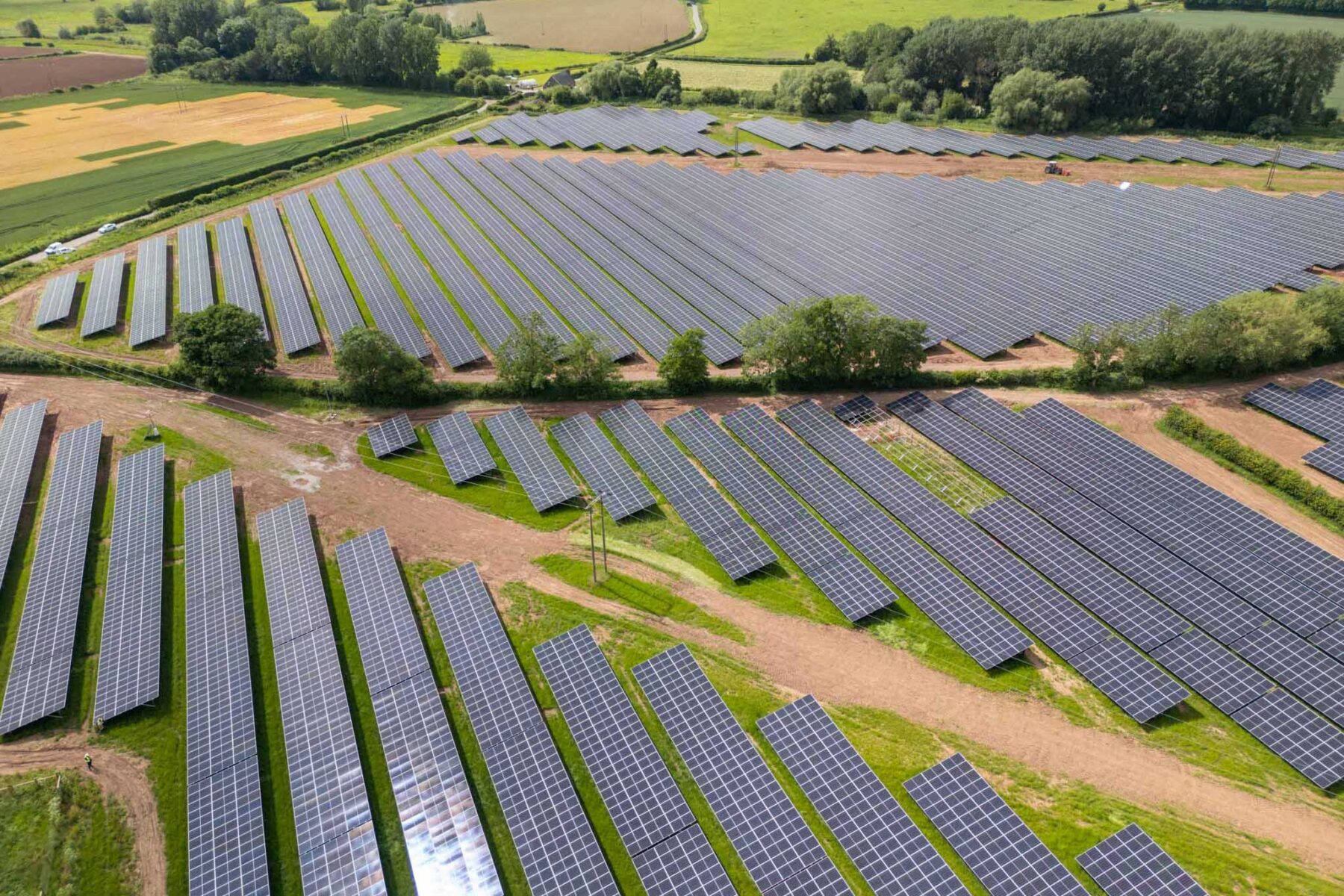
For a solar project you’d need a minimum of 4-5MW to make the cabling economically viable. That would need around 10 – 15 acres, maybe more for access. Much of that land would remain grazable by sheep under the panels.
For wind turbines you’d be looking at a footprint of between 50m2 to 150m2 to allow for maintenance, but again much of that would be grazable.
In terms of energy storage, batteries could require anywhere from half to 6 acres, but it is possible the business may be willing to site that element of any installation on their own land.
What are biodiversity net gain targets and do they cost more money?
Since February of this year, developers have been obliged to provide a 10% biodiversity net gain (BNG). If you’re starting from a grass field, that is actually quite a high benchmark. Adding in wildflower meadows, additional planting from trees and hedegrows and/or bird and bat boxes (location specific) will all contribute to that total. The costs of this will need to be borne by the developer – which could be either you or your energy partner.
Can I do this myself?
In theory you could, but it would take huge quantities of time, knowledge and is likely to be very stressful. You’d have to understand legal documentation, front the considerable costs of planning applications and negotiate the Power Purchase Agreements – all of which can be complicated.
We have a team of experts who handle everything from planning and site design, to sourcing the right equipment and installers, we have relationships with the District Network Operators (DNOs) and many of the specialists required to bring a project to fruition safely.
How disruptive will it be to the farm?
A wind, solar or battery farm can be located and designed in a certain way to minimise the disruption to normal farming activities. The first few months of construction can be quite intensive with a large number of deliveries as equipment comes to site, but then it eases off. Once installed and energised, it is relatively self sufficient with a maintenance van coming every couple of weeks to check things over.
How long does it take to get live?
Depending on the scale and complexity of the project, you could be looking at anything from 18 months to four years.